The artist's manifesto
Why do I make my sculptures the way I do?
A personal answer from Erik Lemcke about the language of form, the task of art and the esoteric striving behind the works.
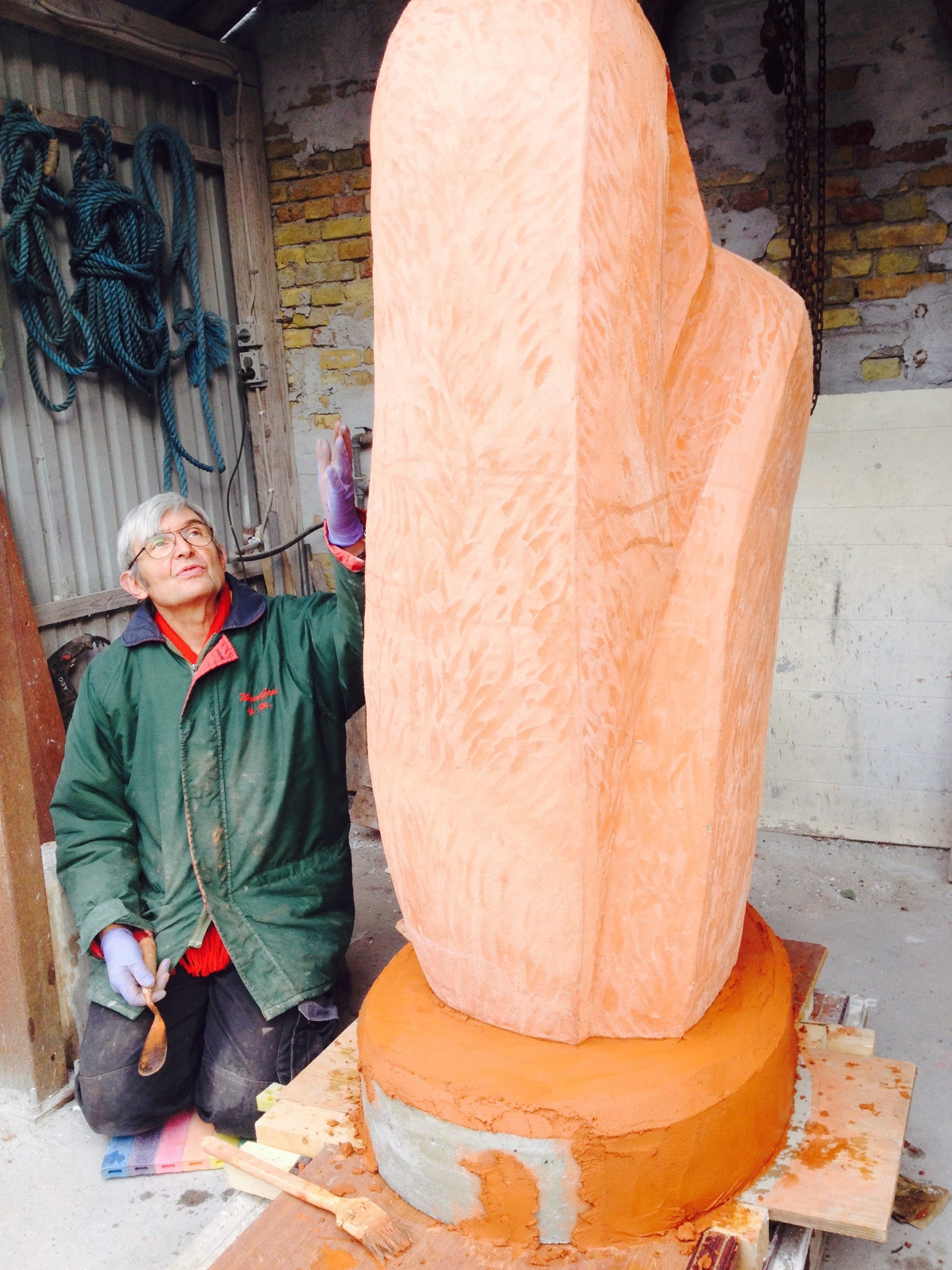
The language of form
What I strive for is to transform a physical material into a form that appears beautiful or aesthetic. I am fond of consistent lines. I love seeing a movement of the lines in a figure when the figure is viewed from different sides.
I strive to work from an organic language of form: a language with very few straight lines, where there is a dynamic alternation between concave and convex lines. A language of form where the same surface may well be both concave and convex, and where the tension of the surface is in constant transformation.
The sculptures I create come out of my thoughts and feelings. It is what flows out of my hands, what I want to shape in wood, clay, granite, bronze or fibre concrete.
I strive for the living in the form, strive for movement, but a movement that appears harmonious. I strive for a form that invites you to want to touch the figure, to let your hands glide slowly and feelingly across the surface. A figure one both wants to look at and to touch.
A figure should be a joy for mind and soul. It should help one feel balance and inner peace. Not a peace that leads to passivity, but a peace that forms the basis for renewed strength and energy to once again go outward into action. To go outward with renewed strength to meet a turbulent and chaotic world.
The task of art
When I look at much of today's art, it is an art that strives to mirror the chaos of our time, to show the horrors of the age, to show everything that overwhelms and feels deadly and fear-inducing in life. It is of course every artist's right to find their own form of expression.
My personal question is: What is it that art needs to say to us human beings today? Is there a need for us to confirm the chaos of the times, the uncertainty and horror, or is it something else that today's and tomorrow's artists are needed for?
For my part, the answer is that one of the tasks of art today is to help stop the chaos, to help transform it. I do not feel I need to point out the chaos. The world manages that without me. Instead, I wish to help provide inspiration so that the world can once again be transformed into a place where people can live with respect and love for one another.
I see the task of art in the same way I see organic and biodynamic farmers: They do not need to poison the earth even more, but have instead taken on the task of transforming the earth into a healthier place to live for all of us, both now and in the future.
The esoteric striving
As a designer and sculptor I strive to create sculptures in many different materials with organic, harmonious, beautiful forms. But my real striving takes its starting point in Rudolf Steiner's description of: where does one find life?
- In the physical world, e.g. in stone, there is no life.
- In the plant world there is life in the form of etheric forces, life forces.
- In the animal world there are moreover astral forces, soul forces.
- In the human world there is moreover an individuality, an I.
The esoteric question I have asked myself in my work as a sculptor is: Is it possible to work with a physical material such as clay, granite and marble in a way such that those who come into contact with my sculptures, visually or through touch, get a sense that there are living forces in my organically shaped sculptures?
I experience myself that this is the case in the best of my sculptures. I also often find that people with a spiritual view of the world express it in various ways.
In the moment of creation
After working with a particular sculpture for a while, a certain moment comes when things change. When this moment of change arrives, it is no longer me alone who creates. I feel connected to something far deeper, and my hands create together with this force.
At the same time I feel filled with love and care, while my perception expands. I sense things in a different way. It is a love of the world and of what is to come. I then know intuitively what to do. My hands know whether to add or remove something. My hands know how the form should manifest itself.
In a way it is easy to create with this guidance. In these moments I feel a deep gratitude and humility.
When I work a stone or granite, I am moreover aware that, as Rudolf Steiner expresses it, I redeem gnomes when I chip pieces away from the stone.
The mission
To create sculptures that bring healing forces to the earth and to social life.
I even know that my best works do exactly that.
I know that I do this by transforming the physical material through cooperation with the elemental beings of the etheric world.
When I work on a sculpture, it happens that my heart fills with a great love for the sculpture and for the world. Perhaps one of the essential things about a sculpture is that it is woven through with love. Love of the material, love of the creating, love of the divine and love of the people who will come to touch the sculpture.
Perhaps gratitude and joy at being allowed to create are a prerequisite for being in those layers of the creative where inspiration flows. Where one is so open and soft that the connection to the universe's creative forces can be activated, and one is allowed to become an instrument that can transform and enliven a physical material.
Erik Lemcke